
Welcome to WordPress. This is your first post. Edit or delete it, then start writing!
Author: user
-
In Final Week, Markets Walk Back July Record Highs
Amid the political conventions of the last weeks, the markets hit records highs but slid back to end the month. Economic news was mixed and political developments didn’t seem to have a material effect.
The Dow was up 2.8% for July after reaching a record 18,622 on July 26. The S&P was up 3.6% for the month. These highs were in contrast to the 20% plunge in oil prices which is seen by some as bearish on the stocks.
Real GDP was up a mere 12.2% for the second quarter which was better than the prior quarter’s .8% but no where near the historical 3.2%. The short fall from expected 2+% was blamed on inventory liquidation and weak oil prices.
Retail sales were healthy but businesses are not spending. Its cheaper for them to hire workers and then firing them when things slow than investing in expensive equipment and then having it sit idle.
Odds slightly favor the Dems retaining the White House, GOP holding onto the House and the Senate is a tossup. Implications for the economy and markets are not favorable but recession is not expected in the nex year. The Fed may hike rates in December but a lot could happen between now and then.
-
3Q SCM Market Review
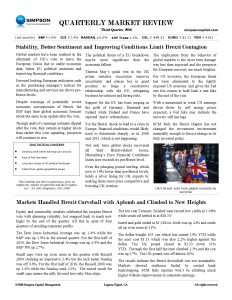
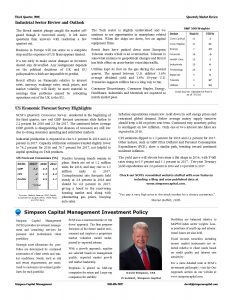
Here the latest client newsletter. For a PDF version, click here Newsletter16Q3.
-
3Q Forecast Survey Summary
SCM’s Quarterly Consensus Survey, conducted at the beginning of the third quarter, saw real GDP forecast consensus slide further to 2.2 percent for 2016 and 2.3 for 2017. The continued below average GDP growth is disappointing but chances of recession are still low due to strong consumer spending and solid labor markets.
Industrial production is expected to rise 0.1 percent in 2016 and 2.0 percent in 2017. Capacity utilization estimates trended slightly lower to 76.2 percent for 2016 and 76.7 percent for 2017, spurring capital spending on Tech products.
Positive housing trends remain in place. Starts are set at 1.2 million units for 2016, and may rise to 1.3 million units in 2017. Unemployment rate forecasts held steady at 4.8 percent in 2016 and should be 4.6 percent in 2017, giving a boost to the recovering housing market and, along with plummeting gas prices, buoying auto sales.
Inflation expectations remain low, held down by soft energy prices and restrained global demand. Below average money supply turnover should keep a lid on prices near term. Continued easy monetary policy is contingent on low inflation. Only one or two interest rate hikes are expected in 2016.
CPI estimates dipped to 1.3 percent for 2016 and 2.2 percent for 2017. Other indices, such as GDP Price Deflator and Personal Consumption Expenditures (PCE), show a similar path, trending toward continued moderate inflation.
The yield curve will elevate but retain a flat shape in 2016, with T-bill rates rising to 0.5 percent and 1.1 percent in 2017. Ten-year Treasury yield expectations are 2.0 percent in 2016 and 2.4 percent in 2017.
[table id=5/] -
3Q Economic Forecast Survey
The following is a more detailed quarterly version of the annumal US forecast survey published above.
[table ID=4/] -
3Q Industrial Sector Review and Outlook
The Brexit vote caught the market off-guard and though recovered nicely, Brexit left more questions than answers with resolution far in the distance.
Business in Britain will not come to a complete stop and the exposure of most US firms appears to be limited.
It’s too early to make sector changes so investors should stay diversified. Any realignment depends on the political decisions of UK and EU policymakers which are impossible to predict.
[table id=3/] -
Markets Hit New Highs As Terror Grips Globe
The week ended on upbeat in spite of the tragedies, which is an indication of the resiliency of the markets.
[table id=2 /]
-
Markets End First Half on Upbeat
US equity market recovered nicely from Brexit to finish the second quarter mostly in the black. The Dow Jones Industrial Average was up 1.4% while the S&P was up 1.9%. Small caps were up even more in the quarter with Russell 2000 clocking an impressive 3.4% but the tech laden Nasdaq was off 0.6%.
The ten year Treasury finished near record low yields at 1.49% while crude oil settled in at $48.33 / barrel and gold ended at $1,318/oz. The dollar bought 103 yen which has soared 14% YTD while the euro cost $1.11 which was also 2.2% higher against the dollar. The UK pound closed at $1.33 down 11% YTD.
For the first half of 2016, the Dow Jones Industrial Average was up 2.9% and the S&P 500 up 2.7%. The Russell 2000 was up 1.4% while the Nasdaq sunk 3.3%. Gold was up 24% and crude oil up even more at 31%. Through the first half the euro climbed 2.3% and the yen was up 17%. The UK pound was off almost 10%.
The results indicate the Brexit downdraft last week was not sustainable and the stock markets seem to be saying recession is still a few quarters out.
-
Decisions Need To Be Made Before Smooth Brexit
After the Conservatives select a new prime minister sometime in September, several financial and structural issues will have be addressed before progress is made on a smooth Brexit.
The financial decisions include phase out of UK’s EU budget contributions and what to to with joint research projects slated to end after Brexit. What are they going to do about British subjects working in EU institutions and what is the status of UK nationals living in EU and EU nationals living in the UK?
Remaining EU leaders will need to set new policy priorities regarding economic growth and security. Negotiations can’t formally Begin until Britain invokes Article 50, official notification of withdrawal, sometime in the fall.
Markets have stabilized somewhat but it will be at least six months before we get close anything resembling normal.
-
Brexit Outlook Lacks Coherence
Initial analysis on Britain’s exit from the EU has been all over the map and has more to do with the personal biases of the prognosticator than substance. I think we need to know who the next prime minister will be (Johnson, May or Gove?) and allow the other leaders time to hammer out positions.
Meanwhile, financial markets will have to simmer while political consensus is reached and corporate leaders can plan and execute under the new contours. The speed of departure is at issue with France demanding a quick and punitive exit while Germany wants to take time and get it right.
The US economy which remains healthy will do OK while waiting as it did through the Greek crisis. Worries are strengthening dollar, sagging business confidence and tightening financials conditions. Households will enjoy cheaper imports, grander European vacations and lower mortgage rates.
Forecasting politics and economics is difficult even in the best of times. Best to relax and let things play out.